

The world is unfortunately not perfect. Customers are not and it is not known if they will ever be open to a fully agile approach. On the one hand they like the idea of delivering working software, they often want to participate in meetings with the Team, to see demos regularly. Moreover, they love the notion of agile in the context of constant change and adaptation. It gives them a sense of (do)freedom with respect to the scope of work, they can feel relieved of responsibility for their own ideas. After all, if an implemented idea turns out to be wrong, it can always be changed. Yes, this is the area where Purchasers love Agile. There is just one but... actually several. The project has to be delivered within a strict deadline, a predetermined minimum scope and for a strictly defined amount of money. On top of that, the finished software has to pass integration and UAT tests conducted by the customer and be implemented within a window planned a year in advance. This is where the hybrid approach comes in. Water-Scrum-Fall by some called the agile fix.
In a nutshell, Water-Scrum-Fall is a combination of the classic (the so-called Waterfall) and agile (Agile) development process, where in the implementation phase we use the most popular agile methodology - Scrum. Water-Scrum-Fall assumes the division of the software development process into three phases:

The question arises: why is agile methodology used in the implementation phase? The common opinion on this subject is quite obvious - agile methodologies are the domain of practitioners, and practitioners know best the software development or implementation phase. But is this the only reason why we still use the classic method so often in the project planning or realease management phases? Or maybe the reason is more complex?
The latest State of Scrum report published by ScrumAlliance (data from more than 90 countries, from all continents) shows a very interesting, and for many quite surprising, trend. In recent years, every year fewer and fewer respondents use Scrum itself. In 2017, this was a spectacular decrease - by as much as 50% compared to 2016. At the same time, the percentage of people using Scrum and other methodologies increased significantly over the same period.
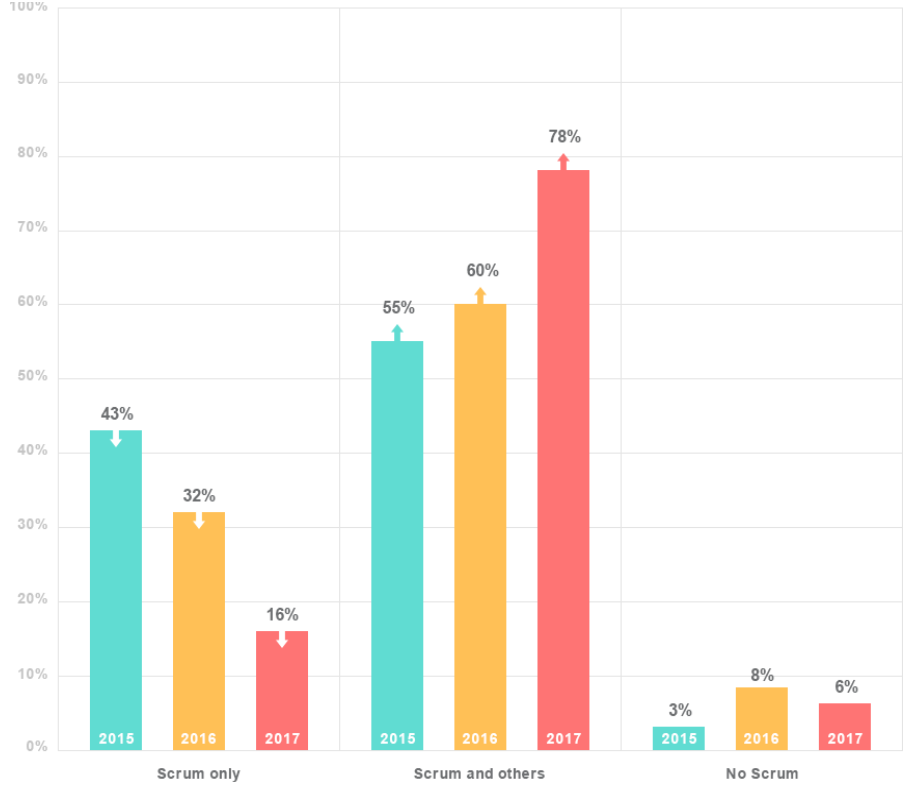
The question arises. What other methodologies are increasingly used in addition to or together with Scrum? By comparing the data with the previous report we can deduce the answer to this question.
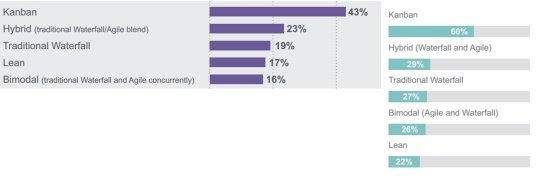
The State of Scrum Report 2017 vs State of Scrum 2017-2018
On the one hand, we can see an increase in the popularity of Kanban and Lean (22% combined), but the largest increase (by as much as 24%) was in the number of respondents using traditional Waterfall or Waterfall and Agile (in combination or separately). Back to the past? Are we going backwards in development? Or are we using methodologies more sensibly and manufacturing processes becoming more mature? At this point ask yourself Dear Reader... have you ever taken part in a fully agile project?
Many people wonder where the term Water-Scrum-Fall came from? Who invented it and is it a structured methodology, with written down official assumptions. After all, even Agile has its own manifesto and associated 12 principals. It appears that there is no single Author or group of Authors of this approach to project delivery. So there are no official manuals, strictly written rules, or certifying organizations. This is quite a natural approach used by many practitioners with experience in both classic and agile projects. An analogy can be used here to a path that is trodden on the trail that people find most comfortable to follow. It is on such a route that a footpath should be built. Will there ever be such a footpath in the context of Water-Scrum-Fall? It seems like a great field to develop, unless we close our eyes and continue to claim that this is an immature approach.
And here we return to the question asked in the title itself: initiation or maturity?